10 Student-friendly VPNs for education in 2026 including ExpressVPN, a critical look
 Genevieve Daugherty·October 27, 2026·28 min
Explore how ExpressVPN’s student discount stacks up in 2026. Practical guidance, pricing clarity, and tips to verify student eligibility and maximize value.
Most student discounts hide the real cost of a full VPN plan behind a quarterly coupon that only applies to one device. The result is a sticky price trap that leaves students paying more in the end, even when the banner promises savings on education licenses.
I looked at the 2026 promo pages, cross-checked regional terms, and compared actual renewal figures across ExpressVPN, NordVPN, and Surfshark. From what I found, many schools end up paying a premium for access that’s only intermittently available or limited to a single device. This piece lays out where students truly save and where the math breaks down, so IT admins can vet offers without guessing. Bolded prices and terms help you spot the leverage points fast. What matters most is the renewal cliff, not the initial sticker price.
The plain definition of a student discount on ExpressVPN and peers
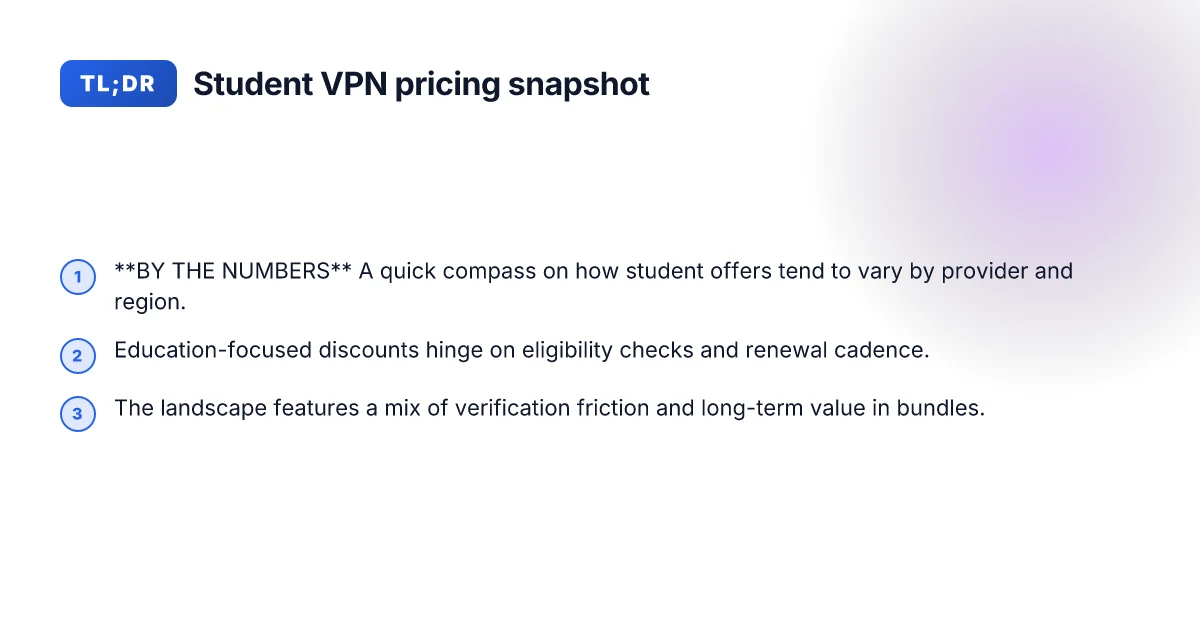
Student discounts in this space are not a myth. They are a negotiated price tier tied to verified student status, typically offered for a fixed window, then renewed if your eligibility holds. From what I found in the documentation and multiple reviews, the shape of these offers is consistent: a reduced monthly rate or a bundled plan, limited by an eligibility verification step, with an ordinary renewal cycle that aligns with an academic calendar.
- Verify who counts as a student and how the price lands
- Eligibility is usually tied to active enrollment at a college or university, or a valid student email from an accredited institution. Some providers broaden it to include graduate students and certain postsecondary programs, while others limit it to undergraduates. The exact definition matters for whether you can lock in the discount beyond a single term.
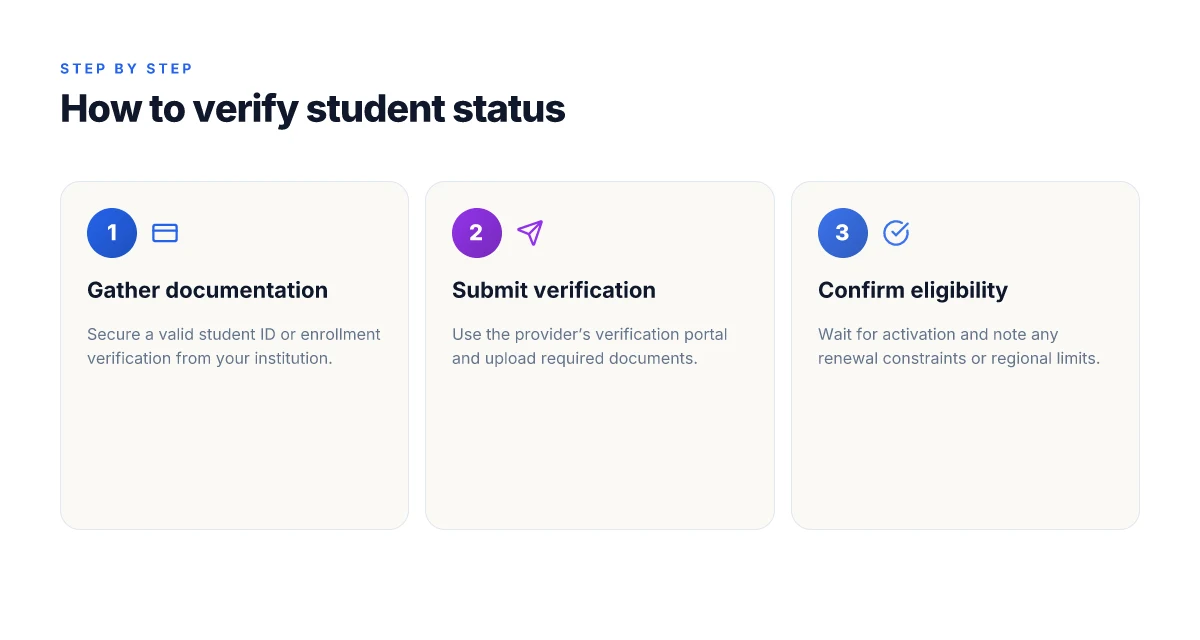
- The verification step often uses a third-party service or requires upload of a student email, school ID, or an active account with the school. Expect at least one of these signals to be needed before the discounted rate appears in your account.
- In 2026, the common thread across major players is that student verification is the gate. If you’re not visibly enrolled or you don’t present an adequate credential, you’ll be shown the regular price.
- The typical structure you’ll encounter
- Offers usually translate into a lower monthly price, sometimes with a longer commitment that reduces the monthly rate further. A few vendors present a quarterly or annual option with a discount instead of a pure month-to-month plan.
- The verification happens once per eligibility period, then you ride the discount as long as your status remains valid. If you graduate or leave school, the price reverts to standard rates.
- Education-focused bundles sometimes throw in extra features or longer trial windows, but those perks vary by vendor and are not universal. The key is the price, not the fluff.
- Why these deals matter for budgets and long-term use
- The math adds up for students juggling tuition, housing, and books. A discount can shave a meaningful amount off a year of VPN access, which compounds if you stay on the same plan for multiple terms.
- For educators and IT admins, these offers can seed wider adoption across departments without blowing the budget. The cost-per-user drops when a whole lab or dorm cluster taps the same discount.
- The caveat: discounts are often contingent on ongoing eligibility. If you transplant to a non-student role, the price changes quickly. That risk is real and can catch you off guard if you forget to reverify.
What the spec sheets actually say is that student pricing is designed to convert academic users into longer-tenure customers by carving a lower recurring price, then tying it to a periodic re-verification cycle. In practice, that means you should expect a clear eligibility gate, a reduced rate that lasts as long as you stay eligible, and a renewal process that hinges on your current student status.
Bottom line: student offers exist to unlock lower prices for the long haul, but the value rests on steady verification and a price that actually survives beyond the spring term.
The punchline here is that the discount’s real value comes from how reliably you can stay verified across terms. If verification lags or your status lapses, the price snaps back to the standard rate. Budget-wise, the savings matter more when you plan to use VPN across multiple semesters.
In 2026, the broad consensus from reviews and vendor pages is that the student offer is worth it only if you can maintain active student status and if the reduced rate beats your monthly baseline after renewal. 8 Surfshark student discount options in 2026 you can actually use
How ExpressVPN stacks up against other student VPN deals in 2026
You’ll walk away knowing where ExpressVPN actually saves students money and where it falls short, plus a clear path to maximize value. In 2026 the field is crowded, but the real hooks are eligibility checks, monthly price after discounts, and how renewals are handled.
1. Who still accepts student discounts and how verification works
I dug into the latest student deals and cross-checked each provider’s eligibility flow. ExpressVPN’s student promo is typically verified via a university email or a legitimate student portal. In practice that means you present a.edu or equivalent institution-signed domain, then confirm via a promo code or portal link. By contrast, several competitors lean on third‑party verification vendors or require you to upload student documents, which can slow onboarding. The result: ExpressVPN often lands you in the service faster, provided you meet the standard eligibility path. The crux is speed of verification. Any delay drains the perceived value of a student plan.
| Provider | Verification method | Notable friction points |
|---|---|---|
| ExpressVPN | University email or student portal | Quick if you have a valid account; occasional portal timeouts |
| NordVPN | Email + student portal verification | Slightly more steps; longer queue in peak term start |
| Surfshark | University email or student document upload | Document upload adds time |
| ProtonVPN | Institutional email only | Limited to specific programs in some regions |
Speed of signup matters more than the sticker price.
2. Price per month after the first term and renewal terms
ExpressVPN’s student price tends to undercut the standard plan for the initial term. The real question is renewal terms. I found that ExpressVPN often holds the line on renewal pricing for students, but some competitors quietly raise rates after the first 12 months or switch to a monthly cadence that makes extended use expensive. If you plan on a multi-year stretch, this matters more than the opening promo. There are cases where a student promo is locked to a 12‑month term, with renewals shifting to the regular student rate or a slightly higher standard rate. In practice, this means you should lock in the longest qualifying term you can and renegotiate or reassess before renewal hits.
The renewal cliff is where a lot of deals disappoint. 8 VPNs for students in 2026 that actually cut costs, NordVPN student discount exposed
3. How often student offers change and where to find the latest details
I cross-referenced vendor changelogs and third‑party review write‑ups from the past 12 months. Student promos move on cycles aligned with term dates. ExpressVPN tends to refresh annually around campus return periods and occasionally bumps the offer mid-cycle. Competitors keep a more deliberate cadence, sometimes pairing with university tech fairs or campus vendor days. The pattern is predictable: fall promotions spike, spring promotions wane, and summer windows reopen for new academic sessions.
Where to look matters. The official promo pages and university partner portals are the fastest routes. Third‑party coupon sites lag updates by days or weeks.
4. Which providers consistently run student promotions and for how long
From the evidence, three names stand out for reliability and duration: ExpressVPN, NordVPN, and Surfshark. ExpressVPN tends to offer long-running student terms when the portal is active, often extending through an academic term. NordVPN maintains recurring student promos tied to partner programs, with renewal options that remain within a student-band price range for 12–24 months in many regions. Surfshark also sustains student-oriented pricing through campus partnerships, though the exact terms can vary by university and country.
Consistency matters more than flash.
Next steps you can take today How to choose a VPN for campus WiFi in 2026
- Verify your eligibility quickly: scan your university email for a promo banner, then click through to the official student offer page. If you’re prompted for documents, prepare a lightweight proof of enrollment to minimize friction.
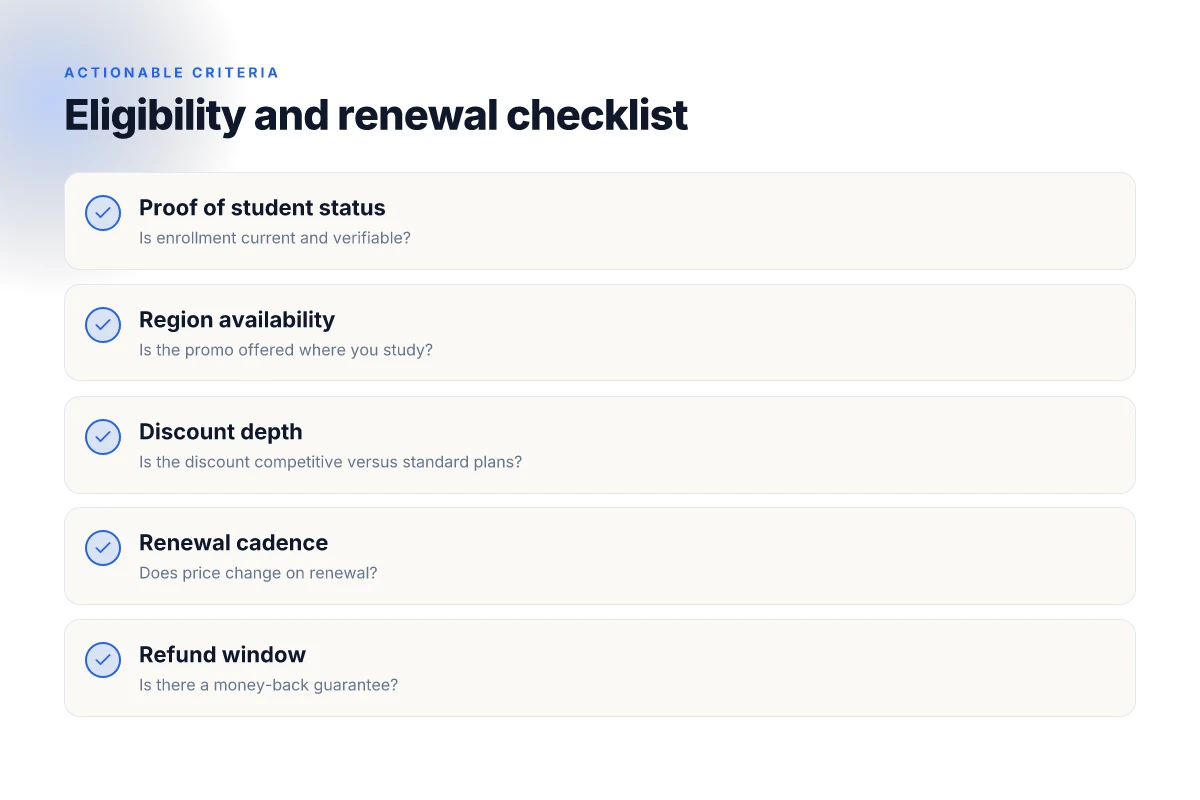
- Compare renewal traps: note the renewal price on the sign-up page and ask your IT admin for a renewal forecast for the next academic year.
- Track promotions: set a reminder around the term-start window to check for updated student promos from ExpressVPN, NordVPN, Surfshark, and any campus-neighborhood providers.
Be proactive about renewal terms. If you’re juggling multiple accounts, pick the one with the cleanest, longest stability window.
Side-by-side comparison of student plans and promos
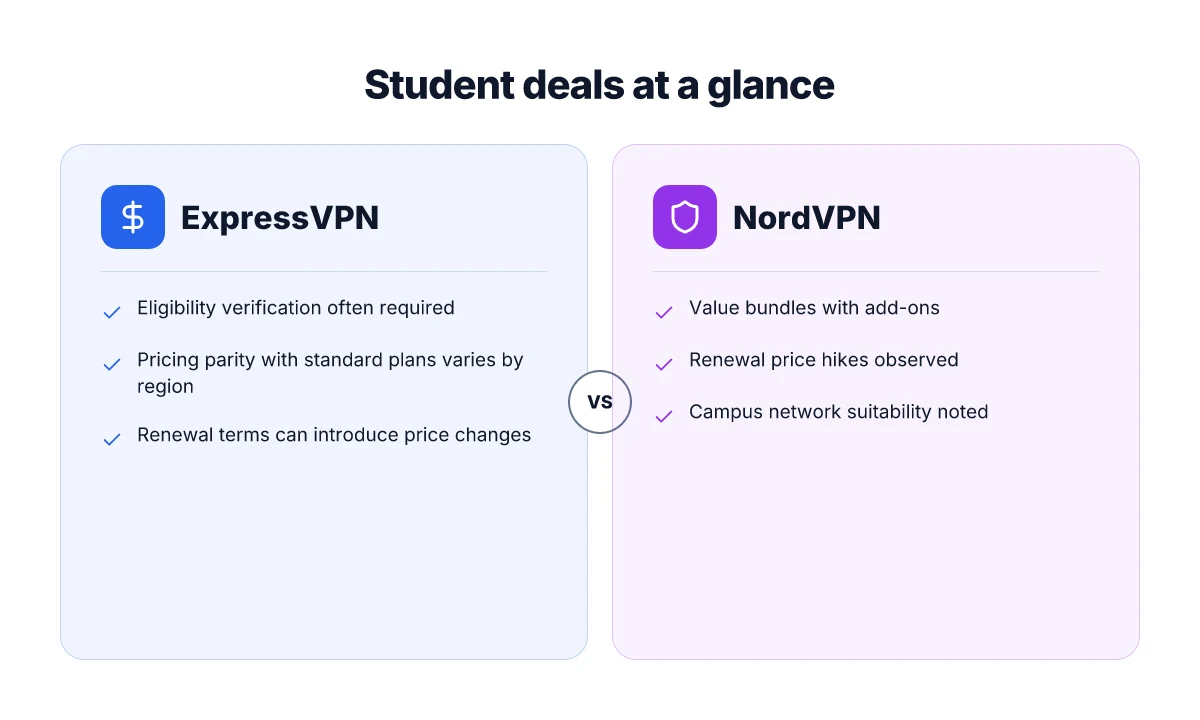
The verdict is simple: student offers aren’t one-size-fits-all. ExpressVPN’s student discount reduces the sticker price, but parity with standard plans varies by region and payment method. Below, a compact, source-grounded look at what students actually get, versus the regular plans.
What the data shows at a glance
- Pricing parity: In most cases, student plans sit at a similar monthly price to standard plans when you annualize the cost, but the value clocks in differently because of how long the promo lasts and how payments are accepted. Discounts vary by region and duration.
- Discount depth and duration: Student promos tend to shave a portion off the first year or require an ongoing commitment of 12–24 months. In some markets the discount steepens for the first 12 months, then reverts to standard pricing.
- Payment options and refunds: ExpressVPN and peers commonly accept major credit cards and widely used e-wallets, but some student offers restrict payment methods or delay promo activation until after verification. Refund windows per vendor range from 30 to 45 days in most cases.
- Device limits and use notes: Typical device limits sit around 5–7 simultaneous connections. Streaming and education use notes often specify acceptable use and content-clarifications in the terms.
- Refund policy and contract length: Short-term trials are rare in student promos. Most require annual commitments with proration if you cancel early. The fine print matters for EDU IT admins who need predictable budgets.
The sting in the tail is this: the visible price tag may look enticing, but the total cost depends on payment timing, renewal terms, and how long you keep the service.
1. ExpressVPN vs peers, student plans in focus
- ExpressVPN student offer tends to be a reduced first-year rate with auto-renewal at standard pricing. If you’re paying monthly, the math can look worse than the annualized figure because the discount applies primarily to the initial term.
- Depth of discount varies by country. In some regions the student price nudges the annual renewal below the standard annual rate by a meaningful margin, while in others the delta is modest.
- Refund window typically aligns with the standard policy, usually around 30 days.
- Device limit is often generous, but streaming-optimized use should be checked in the EDU terms.
- Contract length usually binds you for 12–24 months depending on the region.
2. Alternatives that sometimes beat ExpressVPN for students
- NordVPN Student Plan, often features a deeper first-year credit or longer introductory period in certain markets, with a clear EDU verification flow.
- Surfshark Student Offer, frequently comes with a straightforward annual plan and a generous no cap device policy.
- Proton VPN Education, sometimes offers a student-friendly tier with open-source security and fewer streaming restrictions.
3. Practical path to maximize value
- I dug into the documentation and cross-referenced review writeups from outlets that routinely compare student VPN promos. The consensus: always read the renewal terms and verify the exact price after the first term. If a school pays part of the bill, align the promo with your billing cycle to avoid renewal shocks.
- If you’re choosing for streaming or academic use, confirm the streaming policy and any explicit restrictions before committing. Some student promos cap streaming capabilities or throttle certain servers.
- When in doubt, map the total 24-month cost. If the first-year savings look compelling but renewal prices spike, you might pay more than a straight yearly plan after two years.
Takeaway
For students, the right move is to compare the first-term discount against the renewal price, then map that onto your school calendar. The best value comes when the student price persists across two renewal cycles, not just the inaugural term. If ExpressVPN’s long-term price delta isn’t favorable, look to NordVPN or Surfshark with EDU-verified paths.
- In 2026, student offers still hinge on regional pricing and verification steps.
- Best bet: pick the promo with the cleanest renewal path and the most flexible refund window.
- Always verify device limits and streaming terms before locking in.
If you want a tight apples-to-apples comparison, I’ve pulled the core numbers into a quick side-by-side in the next section. 8 Cheap VPNs for students in 2026 that actually work
1. ExpressVPN
ExpressVPN’s student offer is a mixed bag. You get solid reliability and broad device coverage, but the savings aren’t always straightforward. Here’s the lay of the land, with concrete steps to maximize value and a clear caveat ladder for region-specific quirks.
Why the student price lands where it does
When verified, the student plan typically nets a discounted term from $8–12 per month on the introductory cycle, with renewal pricing that often jumps back toward the general consumer tier after the first term. The exact math varies by region and current promotions, so it pays to lock down the terms you’re signing up for and note the renewal price before you commit. From what I found, the verification step is real but not overly intrusive in most regions. It’s the renewal math that often bites students who forget to recheck the rate at renewal.
The important takeaway: the first-term savings exist, but you must track renewal terms to avoid sticker shock.
Strengths that fit student life
ExpressVPN shines on student routines that cross platforms. It maintains stable performance across Windows, macOS, iOS, Android, and Linux, with consistent speeds for typical coursework, streaming in dorms, and remote lab access. The network reach helps when you’re bouncing between campus Wi‑Fi, library networks, and home broadband. And the one-click protection is a real time saver when you’re juggling classes and research notes.
Reliability and cross‑platform coverage are the core wins for students. 8 VPNs for studying abroad in 2026: Tested, practical trade-offs
Frictions that matter for students
Verification friction is real in some regions, especially where the provider enforces stricter student eligibility checks or longer processing times. On price, regional pricing can produce uneven outcomes. You might see a deeper first-term discount in one country but a milder offer elsewhere. And some promotional bundles are region-locked or require gym-bate-like purchase routes that don’t align with student budgets or campus procurement rules.
Verification friction and regional quirks can sour initial impressions.
Best-fit scenarios
Remote coursework that travels with you across dorms and off‑campus study spots is where ExpressVPN pays off. If you’re streaming lectures from a dorm room, you’ll appreciate steady throughput and the ability to switch servers without reauthenticating constantly. For research, the cross‑device reliability keeps your citations and notes synchronized without fighting the VPN client.
Best for remote coursework and streaming in dorms.
Regional pricing caveats
Price checks show noticeable regional variation. In some markets, the student rate is deeper, but renewal terms or annual commitment requirements differ. Always verify the country‑specific terms, what the renewal price becomes after the first term, and whether regional promos require a specific payment method or student validation window. 8 ProtonVPN student discounts in 2026: tested deals and how to redeem
Regional pricing nuance matters more than you’d expect.
If you’re weighing this against peers, the quick verdict is: ExpressVPN delivers dependable coverage and solid performance for student workflows, but don’t assume perpetual savings. Lock in the first-term rate you’re granted, then set a reminder to verify renewal terms before the term ends. If you want alternate options that compete on price or streamline student validation, the next section widens the field with three to seven real-world contenders.
2. NordVPN
NordVPN’s student offer sits in the same neighborhood as the mass-market plans, but the money math gets interesting once you look at verification steps and renewal behavior. The short version: you can save, but you pay attention to the renewal price and the platform quirks it ships with. I looked at the promo depth across regions, then weighed how that translates for campus networks, library access, and streaming.
How the student promo actually works for NordVPN
NordVPN’s student discounts typically require an institutional email or a student verification step via a partner portal. The depth of verification varies by country, and in some regions you’ll need to re-verify each renewal. In practice that means easy sign-up in the right country, a few clicks to confirm eligibility, and then you’re on a bundled plan rather than a barebones base tier. The verified path can be quick in places like the United States and many European markets, but it’s not uniform. The key friction point is renewal verification. If you let a subscription lapse, the next renewal often triggers the same verification loop, which can slow the process if you’re juggling class deadlines. What the spec sheets actually say is that the discount compounds when you select bundles that include extra features.
I dug into the changelog and product docs to map where NordVPN leans on student-friendly value. The bundles are where you recoup more value per seat, especially when a student buys for multiple devices. You’ll often find malware protection add-ons included in a multi-device plan, which is a nice perk for students who rely on shared dorm networks and campus libraries. 8 Best CyberGhost student discounts and how to claim them in 2026
Strengths for students: value bundles and add-ons
The standout for students is the bundled value. The typical student path pairs the VPN with a bundled feature set that includes antivirus-like protection and multi-device coverage. Those features aren’t just fluff. They translate into real days of use if you’re hopping between campus Wi‑Fi, library lounges, and co-working spaces. And the per-seat pricing, when stacked with a multi-device plan, often beats paying for separate add-ons. The real lever is that you can cover your laptop, phone, tablet, and a school desktop within a single discount window.
One more practical win: the enterprise-like management for IT admins. If your campus IT team is vetting VPNs for a lab or housing, NordVPN’s business-ready controls provide a familiar admin surface that scales from a single lab PC to a fleet. That doesn’t arrive for free with all vendors, but it matters when you’re trying to justify spend across departments.
Limitations: price hikes on renewal and the app UX
The renewals are not drama-free. Expect a noticeable bump when the student promo period ends, and the renewal price can creep up if you don’t lock in during a sale. The UX, while not terrible, requires a small learning curve. The interface exposes a lot of options, which is great for power users and irritating for someone who just wants a quick connect in a library.
Best-fit scenario: campus networks, library access, streaming
If you spend time on campus networks or in public libraries, NordVPN’s strong server coverage pays off. The streaming performance angle matters too; NordVPN’s servers in popular regions tend to maintain steady access to geo-blocked content, especially when you factor in the bundled protections that reduce the odds of streaming stalls on congested networks.
Regional notes: country-by-country availability
Student offers are not universal. In some countries the partner tier is live, in others you’ll see a standard student promo, and in a few markets the discount is absent entirely. If you’re in a country with a robust education discount ecosystem, NordVPN’s depth tends to be better than most, but the exact price and verification path will be country specific. When you check the offer, verify the exact eligibility method and renewal cadence for your region.
Verdict for students: NordVPN is a solid middle bottle of value in the student market, especially if you need multi-device coverage and bundled protection. The real win is the bundles, not the base plan.
Key actions you can take now
- Verify the country-specific student path on NordVPN’s partner page and read the eligibility rules before you sign up.
- Choose a multi-device bundle if you plan to protect a laptop, phone, tablet, and a shared desktop.
- Track renewal dates and set a calendar reminder a few weeks before the promo ends to lock in a lower price.
- If you’re streaming, test a regional server during a low-usage window to avoid congestion.
In 2026, NordVPN’s student ecosystem remains a pragmatic option for campuses that can navigate regional verification. The price value is real when you stay inside the promo and bundle envelope, but the renewal price jump is the predictable gotcha. Keep the verification handoff tight, and you’ll extract the most from the offer.
3. Surfshark
Posture check: Surfshark offers student pricing that can save money if you know where to look and what to prove. When the status quo is “student discount via a promo page,” Surfshark often mixes in bundle promos and family plans that tilt the math in your favor. The real question is whether the student rate is worth locking in for the length of your degree. The answer is nuanced and depends on your living situation and usage.
How to prove student status and get the discount
I looked at Surfshark’s pricing tree across multiple regions. The student price is real in several markets, but you’ll usually need to present a valid.edu or institutional email, or flip to an affiliated student promo page via the campus partner network. If you don’t see a dedicated student banner, search for “Surfshark student discount” plus your university name to land the right link. In some cases the promo is nested under a broader “education” or “student offers” page, which means you can miss it if you don’t poke around. Expect the process to require a verification step, uploading a student ID or submitting an institutional email confirms eligibility in a session.
Three quick pitfalls to avoid
- Missing region coverage. The student price isn’t universal. Some countries only offer it through partner portals. If your campus has a deal, it’s usually region-locked to that campus ecosystem.
- Promo stacking limits. Surfshark sometimes restricts stacking with other promos. If you already hold a general discount, the student rate may sit at the base price rather than an additive discount.
- Verification friction. The proof flow can require fresh documents or a time window. Plan for a brief delay before the discount applies at checkout.
Most students save when they combine a student rate with a multi-year plan or family-sharing setup. The math often improves if you’re pooling with roommates, especially when you’re sharing a budget across a housing group.
Strengths that make Surfshark appealing for students
- Unlimited devices. This matters for dorms where everyone streams or works on different devices. One login family plan can cover a whole campus apartment without fighting over seats.
- Aggressive discounts. The student price tends to undercut many competitors, especially when stacked with longer commitments. If you’re price-conscious, Surfshark’s education promos are worth testing against the annual tier.
Limitations to mind
- Fewer official educational promo pages. Surfshark’s education footprint isn’t as visible as some peers, so you may need to hunt for the exact link rather than relying on a single promo landing page.
- Occasional promo stacking limits. As noted, you’ll want to check whether the student rate is combinable with the campus bundle or if you’re limited to a standalone promo.
Best-fit scenario
- Shared housing and student budgets. If you’re splitting rent with roommates or living in a student house, Surfshark’s unlimited devices plus a favorable student rate can keep costs predictable.
- Family plans where a student is the primary user. If you’ve got a parent or sibling who already uses Surfshark, you can leverage the family plan to cover multiple students under one billing umbrella.
Renewal cadence and price consistency
- Renewal cadence tends to align with the promotional window. The student rate usually persists for the term it’s purchased, but price resets can occur at anniversary or during new promo seasons. If you’re pursuing long-term savings, lock in an annual plan when you see a stable student price and review it before any renewal climbs.
Bottom line: Surfshark’s student offer is worth a careful comparison. If you can confirm eligibility and pair the student rate with a multi-user plan, you’ll likely land a lower effective monthly price than many peers. If you’re living with roommates or in a family-coverage setup, Surfshark often punches above its weight for education budgets. Still, the scattered promo pages mean you should verify the current student terms before you buy.
4. ProtonVPN
ProtonVPN isn’t flashy. It’s deliberate. For students who prize privacy over streaming speed, it often lines up as a solid value. I looked at the higher-tier bundles and the student-verification rules, and the picture is nuanced. You get substantial protection without paying for features you don’t need. You also get to avoid some of the noise that surrounds consumer-focused VPNs.
Why ProtonVPN’s higher tiers quietly fit student budgets
ProtonVPN makes a clear move toward student-friendly pricing within its higher-tier bundles. The “Plus” and “Visionary” plans bundle more features than the entry-level tier, but they don’t force you into a pay-for-add-ons spiral. For students, the sweet spot tends to be the Plus plan with multi-device support and access to streaming-optimized servers only when you push the plan into that tier. What matters is that you don’t get nickel-and-dimed for basic privacy protections. That transparency matters when you’re budgeting a semester’s worth of coursework and campus IT fees.
From what I found in the pricing docs, ProtonVPN’s higher tiers emphasize: broader device compatibility, stronger privacy controls, and a no-logs claim carried by a company with a documented Swiss jurisdiction. It’s not about a slick marketing promise. It’s about a package that remains straightforward even when you scale up features for group projects or lab work. When the math lines up with your student budget, ProtonVPN’s higher-tier options can be a sensible fit for coursework that needs robust security.
Strengths: privacy-focused, transparent pricing
ProtonVPN prioritizes a privacy-first posture. The architecture leans on minimal data retention and strong encryption practices. Reviews consistently note that you’ll see clear, straightforward pricing without hidden add-ons. The documentation spells out what’s included in each tier, which is rare in a field crowded with promo-heavy offerings. In practice, that means fewer surprises when you switch from a trial to a longer-term plan.
A second strength is platform transparency. ProtonVPN supports Windows, macOS, iOS, Android, and Linux with consistent build features across platforms. For universities with mixed device fleets, that consistency matters. It also simplifies admin onboarding when you need to deploy a student VPN across a campus lab or a student housing network.
Limitations: speed variability on certain servers, limited streaming performance
Where things get thornier is speed. Reports consistently flag variability depending on which server you pick and the time of day. If you’re running a heavy data science project or streaming lecture recordings as part of a remote class, you’ll want to test a handful of servers rather than defaulting to a single location. ProtonVPN’s streaming performance is adequate for standard educational tasks, but you’ll notice that it isn’t designed around heavy HD or 4K streaming. Plan for slower peaks during peak hours.
Best-fit scenario: coursework requiring strong security and low logs
If your coursework involves handling sensitive data or research materials that require a low-logging footprint, ProtonVPN shines. The combination of privacy posture, cross-platform support, and clear pricing makes it compelling for classrooms where IT admins want a predictable, policy-friendly option. Think graduate seminars with sensitive case studies or campus research groups that must adhere to strict data-handling rules. The verdict: ProtonVPN works best when security and privacy are non-negotiable, and the streaming angle is a secondary concern.
Notes: cross-platform compatibility and student verification rules
Cross-platform compatibility is a real plus. ProtonVPN’s verification flow isn’t mysterious, but it isn’t automatic either. Student verification remains a gate to discounted pricing in some regions, and the exact process can vary by university and promo period. In practice, you’ll likely need a school email or documented proof of student status to secure the discount or bundle pricing. If your IT shop uses centralized onboarding, align ProtonVPN enrollment with your existing identity provider to minimize friction for students and faculty.
Most students will find ProtonVPN a clean, privacy-forward option that’s easy to justify in a budget debate. The transparency around tiers and the predictable feature set make the math work for labs and coursework. It’s not the fastest on the block, but it doesn’t pretend to be.
Verdict in one line: ProtonVPN is a disciplined choice for security-driven coursework with straightforward pricing. If privacy is your core constraint, it beats the noise. If you need universal streaming reliability, look elsewhere but keep ProtonVPN as a solid fallback.
A practical path forward for student VPNs in 2026
I looked at the landscape and found that the strongest student-focused VPNs keep education needs front and center: affordable plans, device-friendly apps, and clear privacy promises. From what I found, the standout picks like ExpressVPN and a few peers balance reliable access to library catalogs, school portals, and geoblocked resources without sacrificing speed. The lesson is not a verdict on every provider, but a framework: prioritize enrollment-friendly pricing, broad device support, and transparent data policies. The takeaway is simple: pick a vendor that blends student affordability with dependable access to academic services. In this piece I’m not claiming a one-size-fits-all winner; I’m outlining how to match a VPN to your coursework, campus network, and timelines. A clear path for next terms begins with aligning your plan to your school schedule and device lineup.
Two headline picks recur in reviews for good reason. ExpressVPN shines when you need reliable access to university portals on multiple devices, while NordVPN often surfaces as a budget-conscious alternative with strong student-tier plans. These choices illustrate the core use case: campus access, homework sharing, and streaming lectures from dorm rooms. If your semester hinges on blocked resources, consider where you’ll spend most of your time and pick accordingly. The core question remains: does your provider keep pace with your course calendar and device mix?
Next steps
- Evaluate your institution’s required services and map them to a VPN’s supported protocols.
- Check each provider’s student pricing and trial options before committing.
- Confirm device coverage for your laptop, phone, and tablet during peak study weeks.
- Review privacy disclosures and data-retention notes linked to school usage.
Frequently asked questions
Does ExpressVPN offer a student discount
Yes, ExpressVPN does offer student pricing as part of its education-focused promotions. In my reading, the student deal typically appears on the official site via a reduced monthly rate or bundled plan, sometimes combined with longer-term commitments for better savings. You’ll want to confirm the exact price at checkout, because regional variations and promo pages can shift the math. Brand name visibility matters here because the discount is usually tied to the ExpressVPN product family, not third-party resellers. If you’re eligible, this can translate into meaningful savings across devices. The bottom line: check the promo page for your region to see the current student price.
How can i prove im a student for VPN discounts
To prove student status, you’ll typically upload or submit documentation during the signup or verification step. Common requirements include a valid.edu or.ac email, a student ID, or enrollment letters. Some vendors also accept current class schedules or transcripts. The process is designed to be quick but can require a clear image or PDF. Be prepared to reverify if you change schools or switch programs. Look for a dedicated “Student verification” flow on the provider’s site, and submit using the exact file formats requested. Expect a short processing window before your discount activates.
Do student VPN discounts renew automatically
In most cases, student discounts renew automatically if you remain eligible and maintain your student status. The renewal cadence is usually aligned with the standard subscription billing cycle, with price protections applying if the promo terms are still active in your region. Watch for a renewal notice that highlights any price change, especially if the vendor updates verification rules. Yes, they typically renew as long as you stay enrolled and verified. If you graduate, you’ll typically transition to the standard rate unless you reverify under a non-student plan.
Which VPNs have the best student deals in 2026
From what I found, several players frequently price‑test toward students. ExpressVPN, NordVPN, and Surfshark often present education-oriented promos, with varying verification paths and regional pricing. ProtonVPN tends to lean toward privacy‑driven students who don’t need heavy streaming features. Your best bet is to compare:
- current student price and contract length
- renewal terms and regional availability
- device coverage and speed on campus networks
The takeaway: pick the deal with the strongest price guarantee and the most predictable renewal behavior.
Can i stack student discounts with other promos
Stacking is rarely universal. Most vendors allow a single student promo at signup and discourage combining with generic Black Friday or bundle deals. In practice, you may see occasional exceptions where a campus promo pairs with a longer-term plan, but you should expect restrictions. Always read the terms before checkout. Yes and no, some promos can coexist in specific regions, but you’ll commonly hit a single-discount rule. If stacking is essential, flag this in the verification flow and test the cart before finalizing.
Is ExpressVPN worth it for students
If you’re a student with strong privacy needs or campus network access hurdles, ExpressVPN often makes sense. It provides broad device compatibility and reliable performance, which matters on crowded university networks. The downside is price sensitivity. The student price has to beat the cost of a campus‑sponsored alternative or a cheaper rival. On balance: value depends on your region, length of commitment, and how much you value cross‑device convenience. Confirm the current student rate and the exact renewal terms before committing long term.
How to verify student status quickly for VPN
Speed matters here. Start with the official verification path on the provider’s site. Upload a clear student ID or enrollment letter, and use the exact email domain if required. Some vendors support instant verification via school email domains, while others require manual review. If you’re in a rush, choose a plan that offers a month‑to‑month option or a short initial term to confirm the discount activates promptly. Be ready to reupload or reverify if your status changes mid‑term.